
Sweet Corn Exporter from India: What Global Buyers Must Know Before Placing Their First Order
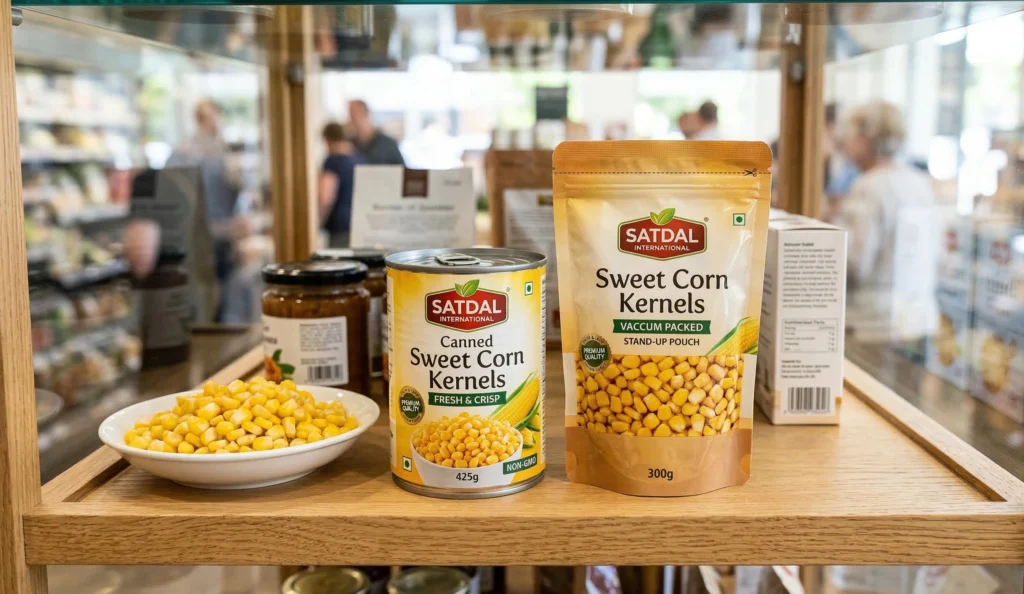
The global food trade is shifting. Procurement managers at FMCG companies, food distributors, and HORECA chains are no longer looking just for the cheapest source — they are searching for suppliers who combine consistent quality, verifiable compliance, and supply chain reliability. For canned sweet corn, one origin is increasingly standing out: India.
India has emerged as a strategically important sweet corn export origin — not simply because of competitive pricing, but because of a unique convergence of Non-GMO raw material, advanced retort processing technology, strong government-backed export infrastructure, and a rapidly maturing contract manufacturing ecosystem. For international buyers comparing suppliers across Thailand, China, Hungary, and India, understanding what differentiates Indian-origin canned and retort sweet corn kernels is now a core procurement intelligence requirement.
This guide provides that intelligence — covering global market dynamics, India’s competitive advantages, industry applications, quality standards, and the specific criteria global buyers should apply when evaluating any sweet corn export company in India.
Global Demand for Canned Sweet Corn: The Market in 2025
📌 Quick Answer — Why is global demand for canned sweet corn growing?The global canned sweet corn market is growing due to rising urbanization, the expansion of convenience food retail, and growing demand for plant-based, clean-label ingredients. The market is particularly strong in the Middle East, Central Asia, and Asia-Pacific, driven by HORECA chain expansion and modern retail growth.
The global canned sweet corn market was valued at USD 3.71 billion in 2025 and is projected to reach USD 5.04 billion by 2034, growing at a compound annual rate of approximately 4.2%. This is not speculative growth — it is demand being driven by structural trends that will persist across market cycles.
Three forces are simultaneously accelerating demand:
1. The convenience food revolution. Changing urban lifestyles across Asia, the Middle East, and Africa are creating consistent demand for ready-to-use, shelf-stable ingredients. Canned sweet corn — ready to drain and use with zero preparation — fits this demand profile precisely across both household and commercial kitchen applications.
2. The clean-label movement. Consumers globally are scrutinizing ingredient labels. Products with simple, recognizable ingredient lists — corn, water, salt — are commanding premium positioning in retail. Indian-origin canned sweet corn, with its Non-GMO credentials and preservative-free processing, is well-positioned to meet this requirement.
3. HORECA recovery and expansion. Following post-pandemic recovery, the hotel, restaurant, and catering sector globally is consuming canned vegetables at scale. Quick-service restaurant chains, cloud kitchens, and airline catering operations all require consistent bulk supply of sweet corn with documented food safety compliance. India’s manufacturing capacity and certification infrastructure meets this professional buying standard.
“Canned sweet corn has transitioned from a commodity pantry staple to a strategic ingredient category — one where sourcing origin, processing method, and compliance documentation now directly affect a brand’s market positioning.”
The United Arab Emirates, Uzbekistan, Malaysia, Saudi Arabia, Qatar, Kuwait, and select South American markets are currently among the top destinations for Indian canned sweet corn exports. Broader demand also flows from the United States, Russia, and across Southeast Asia — reflecting
India’s growing reputation as a trusted sweet corn sourcing origin for global buyers, based on our direct export experience.
Why Import Sweet Corn from India? A Procurement Intelligence View
When procurement teams benchmark sweet corn sourcing origins side by side, India does not simply compete on price. It competes — and often wins — on a multi-dimensional value proposition that impacts total landed cost, supply chain resilience, and product positioning simultaneously.
Advantages of Indian Sweet Corn Processing
100% Non-GMO Raw Material India’s sweet corn cultivation is overwhelmingly Non-GMO — a critical differentiator for importers supplying European retail chains, Japanese markets, and health-focused FMCG brands where Non-GMO claims carry real commercial value.
OEM & Private Label Flexibility Indian manufacturers offer full-service OEM production — custom pack sizes (200g to 3,000g), branded labels in multiple languages, and compliant artwork review — from a minimum of one 20-ft container per SKU.
Retort Sterilization Technology Leading Indian manufacturers use high-pressure short-time (HPST) retort processing — preserving natural color, sweetness, and texture without any preservatives. This is a technical upgrade over commodity canning common in lower-cost origins.
No Cold-Chain Required
Retort and canned packs are fully shelf-stable at ambient temperature. No refrigerated shipping, no cold-storage warehousing — a significant logistics cost saving, particularly for buyers in developing markets.
Government-Backed Certification Exports are backed by FSSAI food safety licensing, APEDA registration, and EIC (Export Inspection Council) certification — a three-layer compliance infrastructure that simplifies customs clearance globally.
Competitive FOB Pricing
India’s domestic sweet corn supply, lower labour costs, and modern processing capacity combine to deliver competitive FOB pricing — without requiring buyers to compromise on food safety documentation or product quality.
India is among largest sweet corn exporter globally by shipment volume.
| Factor | 🇮🇳 India | 🇹🇭 Thailand | 🇨🇳 China |
|---|---|---|---|
| Non-GMO Status | ✔ Yes (standard) | ⚠ Varies by supplier | ✘ GMO widely used |
| Retort Pack Option | ✔ Available | ✔ Available | ✔ Available |
| Preservative-Free | ✔ Yes | ✔ Yes | ⚠ Check per supplier |
| Govt. Export Certification | ✔ APEDA / FSSAI / EIC | ✔ FDA Thailand | ✔ GACC |
| OEM / Private Label MOQ | ✔ 1 × 20ft container | ⚠ Higher MOQs typical | ⚠ Higher MOQs typical |
| Pricing Competitiveness | ✔ High | ✔ High | ✔ Very High |
| Documentation Depth | ✔ Comprehensive | ✔ Good | ⚠ Variable |
Applications of Canned Sweet Corn in the Food Industry
📌 Quick Answer — What industries use canned sweet corn?Canned sweet corn is used across HORECA (hotels, restaurants, catering), packaged food manufacturing, quick-service restaurants (QSR), ready-meal producers, pizza chains, soup manufacturers, salad producers, baby food processors, and retail private label brands. Its ambient shelf life and ready-to-use format make it one of the most versatile commercial vegetable ingredients globally.
Understanding the end-use landscape for canned sweet corn is important for importers building the right product mix. Demand is distributed across multiple professional buyer segments, each with distinct volume, pack size, and specification requirements:
Pizza Chains & QSR
Salad & Deli Applications
Soup & Sauce Manufacturing
Ready Meal Production
Hotel & Catering (HORECA)
Baby Food Formulation
Retail Private Label
Mexican & Asian Cuisine
Packaged Food Ingredient
In the HORECA sector, canned sweet corn is a cornerstone ingredient across cuisines — Chinese manchurian, Indian curries, Asian salads, Mexican wraps, pasta dishes, and pizza toppings. The institutional kitchen’s focus on consistency, cost-per-serving, and ease of use makes large-format retort or tin-pack sweet corn (1kg–3kg) a preferred procurement choice over fresh or frozen alternatives requiring refrigerated storage.
In packaged food manufacturing, sweet corn kernels are incorporated into frozen ready meals, dehydrated soup mixes, pasta salads, and snack seasonings. Manufacturers specifically value the consistent Brix levels (sugar content profile) of retort-processed Indian sweet corn — predictable sweetness is a formulation requirement, not a preference.
For buyers interested in Satdal International’s full range of Ready to Eat Food products, sweet corn is one of several shelf-stable options available for export.
Quality Standards in Sweet Corn Export from India
📌 Quick Answer — What certifications do Indian sweet corn exporters have?Verified Indian sweet corn exporters hold FSSAI food safety licenses, APEDA export registrations, and EIC (Export Inspection Council) certifications. Reputable manufacturers also provide third-party lab reports for pesticide residues, microbial safety, and Brix levels. ISO 22000 or HACCP, BRC certification indicates an advanced quality management system.
Quality in food export is documented, not assumed. A credible Indian sweet corn export company will proactively provide the following compliance documentation — and a buyer’s failure to request it is a procurement risk:
- FSSAI License — Food Safety and Standards Authority of India. Mandatory for all food manufacturers operating legally in India. Verify the license number at fssai.gov.in.
- APEDA Registration — Agricultural and Processed Food Products Export Development Authority. Confirms registered exporter status with the Government of India. Verify at apeda.gov.in.
- EIC Certificate (Export Inspection Council) — Confirms government-level inspection and quality compliance for each export shipment.
- Third-Party Lab Reports — NABL-accredited lab analysis covering pesticide residue levels (MRLs), microbial contamination, heavy metals, and Brix reading (typically 9–14° Brix for commercial sweet corn kernels).
- Non-GMO Declaration — Written supplier declaration; third-party Non-GMO verification available for destination markets requiring it (EU, Japan, South Korea).
- Phytosanitary Certificate — Issued by the Plant Protection Organization confirming the product meets the importing country’s phytosanitary requirements.
- Halal Declaration / Certificate — Sweet corn is inherently halal (no animal-derived ingredients), but formal third-party halal certification is available for Gulf and Southeast Asian market requirements.
- Shelf Life & Batch Documentation — Production date, batch number, and best-before date traceability for every shipment. Shelf Life is 24 Month from date of pack.
⚠ Buyer Advisory: Always verify that the company presenting credentials is the actual manufacturer, not a trader. Request facility images, production capacity data, and a video verification call. Manufacturer-direct sourcing eliminates quality variability introduced by multi-supplier aggregation.
How to Choose a Reliable Sweet Corn Exporter from India
The Indian food export landscape includes both genuine manufacturer-exporters and trading companies that broker third-party production. For buyers who require consistent quality across repeat orders, the distinction is critical. Here is a structured evaluation framework:
| Evaluation Criterion | What to Verify | Red Flag |
|---|---|---|
| Manufacturer Status | Ask for factory address, production capacity figures, and facility photos | Reluctance to share facility details; registered office address only |
| Certifications | Request FSSAI license number + APEDA certificate; verify independently | Certificates without verifiable license numbers |
| Lab Reports | Ask for recent NABL lab reports on pesticide residues and microbials | Outdated reports or refusal to share |
| Sample Policy | Professional exporters provide paid commercial samples with full labelling | Free samples with no labelling or traceability information |
| Export Track Record | Request prior export documentation or buyer references from similar markets | No verifiable export history; vague delivery timelines |
| Payment Terms Transparency | Clear Incoterms (FOB/CIF), payment structure (LC/TT/advance), itemized quote | Bundled pricing with no breakdown; pressure for large advance payments |
| OEM Capability | Artwork compliance review, multi-language label printing, lead time for OEM orders | Claims OEM but cannot show examples of completed OEM shipments |
Why International Buyers Choose Satdal International as Their Sweet Corn Export Partner
📌 Quick Answer — Who is the leading sweet corn exporter from India?Satdal International is a Gujarat-based manufacturer and sweet corn exporter from India, producing FSSAI-certified, preservative-free canned and retort-packed sweet corn kernels. They offer Non-GMO sourcing, retort pouch technology, OEM private label production, and full export documentation for global importers and HORECA buyers. MOQ starts from one 20-foot container.
Satdal International is a Gujarat-based manufacturer-exporter . Every batch of canned and retort sweet corn leaving our facility is produced under our own quality management system, documented with full batch-level traceability, and backed by the certifications international buyers require.
Direct price transparency. Buyers receive itemised FOB pricing covering raw material, processing, packaging, and freight.
Retort technology with proven shelf life. Our sweet corn kernels are processed using retort sterilization that delivers a 24-month ambient shelf life with no artificial preservatives. Ingredients are simply: sweet corn, water, sugar, and salt. This clean label profile is a product marketing asset, not just a compliance point.
Pack size flexibility for every buyer profile. We produce retort pouches and metal can packs across a range from 300g to 3,000g, designed to serve retail, food service, and industrial buyers within a single supplier relationship. Custom net weights and OEM/private label options are available from one 20-ft container MOQ per SKU.
Export documentation as standard. Every Satdal International shipment includes: commercial invoice, packing list, APEDA certificate of origin, phytosanitary certificate, FSSAI documentation, lab test reports, and bill of lading — without supplementary charges. Compliance documentation is built into our export process, not added after the fact.
Non-GMO supply chain commitment. We source sweet corn from verified Non-GMO farms and maintain supplier documentation that traces raw material origin — essential for buyers selling into European, Japanese, or premium retail channels where Non-GMO claims require substantiation.
Request a Sample or Quote Today
The Future of the Sweet Corn Export Market: What Buyers Should Watch
The sweet corn export market in 2025–2030 will be shaped by four converging forces that procurement teams and food brand managers should build into their sourcing strategy today:
1. Clean-label demand will continue to intensify. Regulatory and consumer pressure in Europe, the UK, and Japan is raising the bar for food ingredient transparency. Exporters who cannot document Non-GMO status, preservative-free processing, and full farm-to-port traceability will lose shelf space in premium markets. Indian manufacturers who have invested in this documentation infrastructure are ahead of the curve.
2. Retort technology will replace traditional canning at scale. The combination of better nutrient retention, lower weight, reduced logistics cost, and smaller environmental footprint makes retort pouches the dominant format of the future. India’s early investment in retort processing gives its manufacturers a technological lead over commodity canning-focused origins.
3. Supply chain diversification will remain a strategic priority. The post-pandemic rethinking of single-origin dependence has accelerated. Buyers who consolidated sourcing into Thailand or China exclusively are now actively building India as a parallel supply lane — both as a cost optimisation strategy and as supply chain risk management.
4. Private label growth in emerging retail will drive new volume. As modern retail expands across the Middle East, Africa, and Southeast Asia, the appetite for private label canned vegetables is growing proportionally. India’s OEM manufacturing ecosystem — capable of delivering custom-labelled sweet corn at competitive cost from accessible MOQs — is structurally well positioned to capture this growth.
Conclusion
For global importers, distributors, HORECA procurement managers, and private label food brands, India has earned its position as a first-choice sourcing origin for canned and retort sweet corn. The combination of Non-GMO raw material integrity, advanced retort processing technology, government-certified export infrastructure, OEM flexibility, and competitive total landed cost creates a procurement value proposition that no other single origin currently matches entirely.
The variable is the supplier. The difference between a verified manufacturer-exporter and an unvetted trading company can mean the difference between a successful long-term supply partnership and costly quality incidents. The evaluation framework outlined in this guide — certifications, lab reports, facility verification, sample policy, and documentation depth — is the professional standard that separates reactive procurement from strategic sourcing.
Satdal International welcomes verified international buyers to initiate a supply inquiry. Our export team is equipped to provide samples, full compliance documentation, and a detailed FOB quotation within 24 business hours.