
Psyllium Husk Manufacturer and Exporter from India — BRC, USFDA, ORGANIC NOP, HALAL, ISO & HACCP Certified
Satdal International is a psyllium husk manufacturer and exporter based in Gujarat, India, supplying food manufacturers, nutraceutical companies, pharmaceutical formulators, and private label brands across 30+ countries. Our husk is available in 85%, 95%, 98%, and 99% purity grades to match your product’s regulatory and formulation requirements.
Importance of Psyllium Husk
Global demand for natural, gluten-free and plant-based fiber is growing across three separate industries at once: pharmaceutical laxatives & fiber supplements, gluten-free and clean-label food manufacturing, and nutraceutical/functional food products. India supplies the large majority of the world’s psyllium husk, and Gujarat’s Unjha region — with its specific soil and climate conditions — cultivate and produces husk with a higher mucilage and swell-volume profile than most other growing regions. For an importer, this means origin and processing quality directly affect your finished product’s performance, not just your ingredient cost.
What is Psyllium Husk?
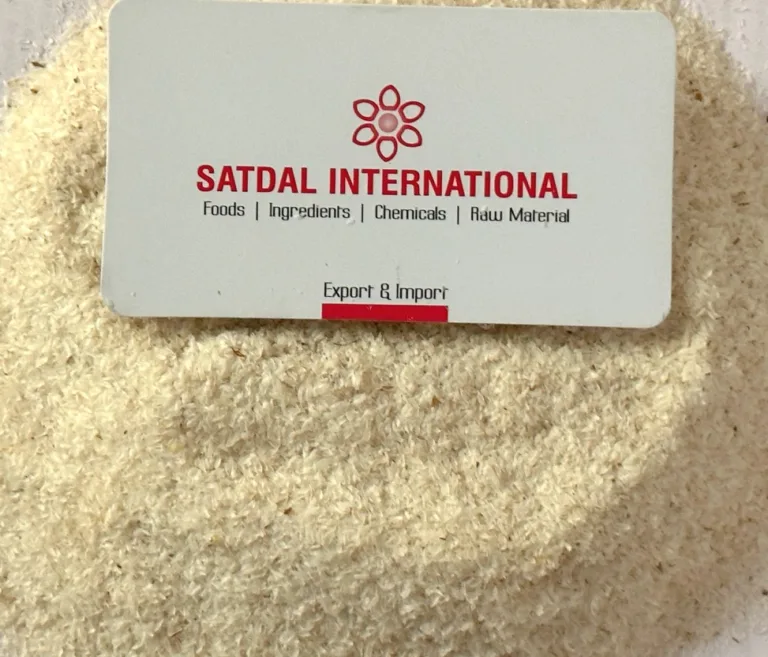
Psyllium husk is the outer seed coating (epidermis) of the Plantago ovata plant, separated mechanically from the seed during processing. It is also known by its Indian trade names Isabgol and Ispaghula husk. The husk itself is almost pure dietary fiber — it contains the mucilage layer that gives psyllium its defining property: when it contacts water, it swells and forms a gel, which is why it is used as a fiber source, a natural thickener, and a binding agent.
We offer Psyllium husk is in three primary forms:
- Whole husk (flakes) — used mainly in pharmaceutical fiber supplements and premium food applications
- Psyllium husk powder — finely milled husk for easier blending into baked goods, beverages, and supplement capsules
- Industrial / Kha-Kha powder — a coarser, lower-cost grade used in industrial and non-food applications
- Psyllium Seeds — Raw Seeds for further process.
If you’re sourcing the whole seed rather than the processed husk, see our psyllium seeds page.
Product Overview
| Parameters | Detail |
|---|---|
| Botanical source | Plantago ovata |
| Common trade names | Isabgol, Ispaghula Husk, Psyllium Husk |
| Forms available | Whole husk, husk powder, industrial powder |
| Purity grades | 85%, 95%, 98%, 99% |
| Fiber content | 75–80% total dietary fiber (approx. 50–55% soluble, 25% insoluble) |
| Color | Off-white to light beige |
| Certifications | BRC, USFDA, ORGANIC NOP, HALAL, ISO, HACCP |
| Shelf life | 18–24 months from manufacture date (grade and packaging dependent) |
| Origin | Gujarat, India |
Technical Specification
| Description | Psyllium Husk 85% | Psyllium Husk 95% | Psyllium Husk 98% | Psyllium Husk 99% |
|---|---|---|---|---|
| Interpretation | Plantago Ovata Frosk Husk. The Odour is not Marked | Plantago Ovata Frosk Husk. The Odour is not Marked | Plantago Ovata Frosk Husk. The Odour is not Marked | Plantago Ovata Frosk Husk. The Odour is not Marked |
| Taste | Blend Mucilaginous | Blend Mucilaginous | Blend Mucilaginous | Blend Mucilaginous |
| Acid Insoluble Ash | 1% Max | 1% Max | 1% Max | 1% Max |
| Total Ash | 4% Max | 4% Max | 4% Max | 4% Max |
| Moisture | 10% Max | 10% Max | 10% Max | 10% Max |
| Light Extraneous Matter | 15% Max | 5% Max | 2% Max | 1% Max |
| Heavy Extraneous Matter | 0.5% Max | 0.5% Max | 0.5% Max | 0.5% Max |
| Swell Volume | 35 ml/gm Min | 50 ml/gm Min | 60 ml/gm Min | 70 ml/gm Min |
| Insect Infestation | Not more than 100 insect fragments including mites and psocids per 25 grams | |||
Why swell volume matters: swell volume (ml/g) is the single best indicator of a psyllium husk’s functional performance — it determines gelling strength in beverages, binding capacity in tablets, and water-holding capacity in baked goods. Higher-grade husk isn’t just “more pure,” it performs better in your finished product.
Regulatory note for US buyers: to carry the FDA’s coronary heart disease (CHD) health claim under 21 CFR 101.81, psyllium husk must have a purity of at least 95%, contain 3% or less protein, and keep combined extraneous matter at or below 4.9%, measured by USP methodology. Our 95%, 98%, and 99% grades meet this threshold; the food must also deliver at least 7g of soluble fiber per day to qualify for the claim.
Nutritional Information (per 100g husk, typical values)
Nutrient | Value |
Total dietary fiber | 75–80g |
Soluble fiber | 50–55g |
Insoluble fiber | 20–25g |
Protein | ≤3% (95%+ grades) |
Fat | Negligible |
Calories | Low — fiber is minimally metabolized |
Psyllium Grade Application
| Application Type | Recommended grade | Why |
|---|---|---|
Pharmaceutical / fiber supplement brands |
98% or 99% USP |
Meets pharmacopoeia purity and CHD health claim requirements |
Nutraceutical / functional food companies |
95–98% |
Balances purity with cost for capsule and sachet products |
Bakery, gluten-free food manufacturers |
85–95% |
Functional binding without pharma-grade cost |
Industrial / non-food, cattle feed |
Industrial (Kha-Kha) grade |
Cost-efficient bulk fiber where pharma purity isn't required |
Application
Food Industry Uses
- Gluten-free
- Bread, flatbread, and baked goods (binding and moisture retention)
- Fiber-fortified
- Beverages and drink mixes
- Fiber bars
- Functional snacks
- Noodle and pasta manufacturing
- Texture improvement
Pharmaceutical & Nutraceutical Uses
- Bulk-forming
- Laxative products
- Fiber supplement
- Capsules, sachets, and powders
- Cholesterol-management
- Formulations (FDA CHD claim eligible at 95%+ purity)
Industrial & Other Uses
- Cattle and animal feed
- Digestive health
- Paper and textile
- Sizing applications
- Cosmetic and personal care
- Formulations requiring natural thickeners
Manufacturing Process
- Sourcing — Seeds procured from registered /direct farmers.
- Cleaning — Mechanical de-stoning and de-dusting to remove foreign matter
- Husking — Mechanical separation of husk from seed
- Grading — Sieving and grading by purity percentage and mesh size
- Milling (for powder) — Fine grinding to required mesh size (40–100 mesh)
- Sterilization — Microbial reduction to meet food-safety limits
- Quality testing — Batch testing against purity, moisture, ash, and microbial specifications
- Packing — Filled and sealed under controlled humidity conditions
Quality Checking Process
Every batch is tested for:
- Purity percentage (USP method)
- Moisture content
- Total ash and acid-insoluble ash
- Swell volume
- Microbial limits (E. coli, Salmonella, yeast & mould count)
- Light and heavy extraneous matter
Packaging Options & Cotainer Load
Export Pack: 25 Kg & 50 Kg for High Volume ( HDPE and Paper Bags )
Custom Pack: 100 Gm to 1 Gm for Retails Pack
20Ft Container: 9 Mt
40Ft Container: 17-18 Mt
- Shelf life: 18–24 months from date of manufacture in original, unopened packaging
- Storage conditions: Ambient temperature, away from direct sunlight and moisture
- Handling note: Keep bags sealed between uses; psyllium husk is hygroscopic and will absorb ambient moisture if left open
Minimum Order Quantity & Lead Time
MOQ: 500 kg and one week after order confirmation. ( Actual at time of order )
Private Lable Service
Satdal International offers private label packaging for retail and supplement brands, including custom pouch sizes, branded labeling compliant with destination-market food labeling laws, and OEM formulation support for blended fiber products.
Countries We Serve
Satdal International exports psyllium husk and related agri-commodities to buyers across:
USA, Canada, UK, Europe, Middle East, Japan, South Korea, Taiwan, Australia, New Zealand, Africa, Latin America, Thailand, Turkey, and other Asian markets.
Buyer Checklist - verify before order
- Confirmed purity grade matches your regulatory requirement (95%+ for FDA CHD claim)
- Certificate of Analysis provided per batch
- Certifications valid and verifiable (BRC, ORANIC NOP,HACCP, HALAL, USFDA)
- Sample tested in your own lab before bulk order
- MOQ and lead time
- Packaging Options
- Export documentation
Importer Guide -Sourcing Psyllium From India
Most psyllium husk imported worldwide originates in Gujarat, India, largely because of the region’s soil and climate conditions and decades of processing infrastructure built around the Unjha market yard. When sourcing, importers should treat purity grade as a starting point, not the whole picture — swell volume, microbial testing, and consistent moisture content matter just as much for real-world product performance. First-time importers should always request a small trial shipment before committing to a full container order, and should independently verify certification documents rather than relying on supplier-provided copies alone.
FAQ
What is the difference between psyllium husk and psyllium husk powder?
What purity grade should I choose for a dietary supplement product?
Which country produces the most psyllium husk?
What certifications should I look for in a psyllium husk supplier?
How is psyllium husk manufactured?
What is a typical MOQ for psyllium husk export?
What is shelf life of Psyllium husk?
Common Mistakes Buyers Make
- Choosing purity grade by price alone — a lower grade may not meet your destination market’s regulatory requirements, leading to rejected shipments.
- Not requesting an independent lab test on samples — supplier-provided COAs should be verified, not assumed accurate.
- Ignoring swell volume — two suppliers can both offer “95% purity” with very different functional performance.
- Skipping certification verification — always confirm certificates directly with the issuing body, not just the supplier’s copy.
- Underestimating lead time during Gujarat’s off-season — psyllium is harvested seasonally; ordering outside peak processing months can extend lead times.
How to Choose Right Supplier
Look for: a supplier who publishes actual specification numbers (not just “high quality”), holds verifiable certifications, provides a Certificate of Analysis per batch, has direct manufacturing (not just trading) capability, and gives you a straight answer on MOQ and lead time before you have to ask three times.
Why Choose Satdal International
Satdal International is a BRC, USFDA, ORGANIC NOP, HALAL, ISO, and HACCP certified manufacturer’s representative and global sourcing partner, working directly with processing facilities in Gujarat to supply export-grade psyllium husk to food manufacturers, nutraceutical companies, and private label brands across more than 30 countries. We provide full specification transparency, batch-level documentation, and direct support through every stage of the export process — from sample approval to container dispatch.
Related Products
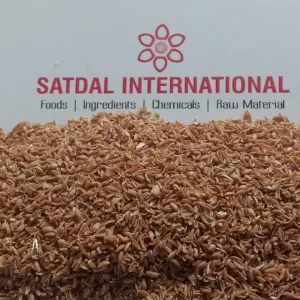
Psyllium Seeds
Psyllium seeds are small, gel-like fibers derived from the “Plantago ovata” plant, commonly used as a dietary fiber supplement.
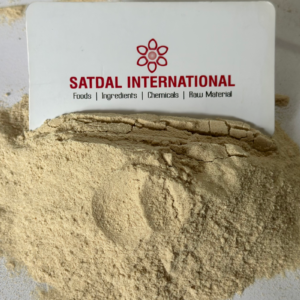
Psyllium Husk Powder
Finely ground form of psyllium husk, known for its high fiber content and use as a natural laxative.
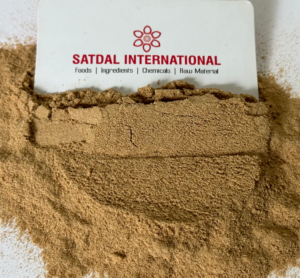
Industrial kha Kha Powder
Powdered form of psyllium husk used in various industrial applications, such as pharmaceuticals or food manufacturing.