
Psyllium Husk Powder Manufacturer and Bulk Exporter - Fine Mesh, Food-Grade, Export-Ready
Satdal International supplies fine-mesh psyllium husk powder to food manufacturers, beverage formulators, bakery producers, dairy processors, and nutraceutical companies sourcing bulk quantities from India. Our powder is milled from the same certified psyllium husk used across our whole-husk line, ground to consistent mesh sizes for reliable blending, dispersion, and formulation performance.
Product Overview
Quick Answer: Psyllium husk powder is whole psyllium husk mechanically milled to a controlled particle size — typically 40 to 100 mesh — for manufacturers who need faster dispersion, easier blending into dry mixes, and consistent texture in finished products. It carries the same fiber content as whole husk; the difference is particle size and how it behaves in processing.
Technical Specifications of Psyllium Husk Powder
Our Psyllium Husk Powder is manufactured from premium-quality Plantago ovata husk and processed under strict quality standards to meet the requirements of the global food, nutraceutical, pharmaceutical, and industrial markets.
| Parameter | Detail |
|---|---|
| Base Material | Milled Plantago ovata husk |
| Mesh Sizes Offered | 40, 60, 80 and 100 mesh (custom mesh sizes available on request) |
| Purity Grades | 85%, 95%, 98% and 99% (same quality grades as whole psyllium husk) |
| Moisture Content | Maximum 10% |
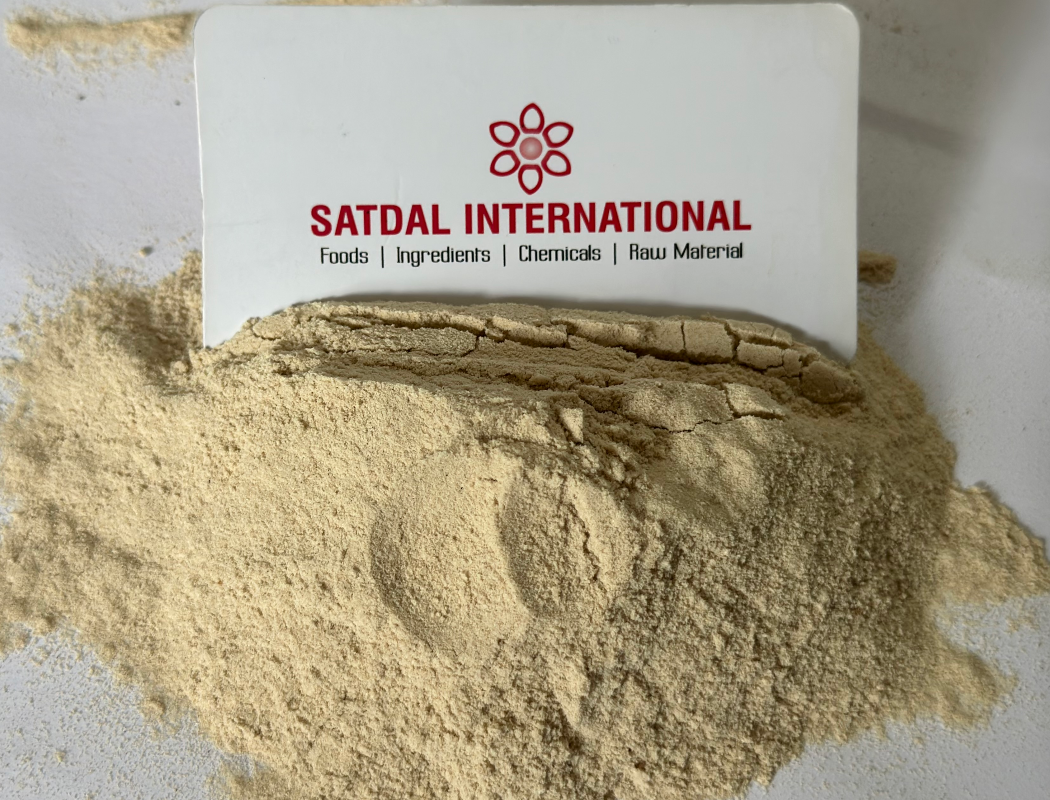
| Color | Off-white to light beige fine powder |
| Certifications | Produced in a facility certified for BRC, USFDA, Organic NOP, Halal, ISO, and HACCP, ensuring international quality and food safety standards. |
| Typical Buyers | Food manufacturers, bakeries, beverage companies, nutraceutical manufacturers, pharmaceutical companies, ingredient distributors, and private label brands. |
| Country of Origin | Gujarat, India |
What is Psyllium Husk Powder?
Psyllium husk powder is produced by milling cleaned, graded psyllium husk to a specific mesh size rather than leaving it in flake form. For manufacturers, the practical difference from whole husk isn’t nutritional — fiber content is essentially unchanged — it’s functional: powder disperses faster in liquid systems, blends more evenly into dry premixes, and doesn’t leave visible flake particles in a finished product.
If your formulation calls for whole husk flakes instead — common in premium capsule and sachet supplement formats — see our psyllium husk page for flake-form specifications.
How Psyllium Husk Powder is Manufactured
- Sourcing husk — Cleaned, graded whole husk is drawn from the same processing stream used for our flake-form product.
- Milling — Husk is ground on calibrated milling equipment to the target mesh size (40–100 mesh).
- Sieving — Milled material passes through mesh screens to remove oversize or undersize particles and hold a consistent particle-size distribution batch to batch.
- Moisture control — Powder is monitored and held at or below 10% moisture, since finer particle size increases surface area and hygroscopic sensitivity relative to whole husk.
- Sterilization — Microbial reduction is applied to meet food-safety limits before packing.
- Quality testing — Each batch is tested for purity, moisture, mesh consistency, and microbial limits.
- Packing — Powder is packed under controlled humidity in poly-lined bags to protect against moisture uptake during transit and storage.
Why mesh consistency matters more for powder than for flakes: a wider particle-size distribution in a milled powder shows up directly in your process — as uneven hydration in a beverage batch, dusting/segregation in a dry premix, or inconsistent dough hydration in bakery applications. This is the main quality variable that separates a well-milled export powder from a low-cost bulk grind.
Industrial Applications
Food Processing Uses
Psyllium husk powder is used as a functional fiber and binding agent in processed food formulations where fine, dust-free dispersion is required — fiber-fortified snack bars, extruded products, and functional food premixes.
Bakery Applications
In gluten-free and high-fiber baking, powder form blends into dry flour mixes far more evenly than flakes, improving dough hydration consistency and reducing visible fiber specks in the finished crumb.
Beverage Applications
Fine-mesh powder (typically 80–100 mesh) disperses faster in both hot and cold liquid systems, which matters directly for beverage manufacturers running continuous-mix lines where flake material would settle or clump.
Nutraceutical Uses
Powder is the standard input format for capsule filling, sachet blending, and tablet premixes, where consistent particle size affects fill-weight accuracy and compression behavior.
Pharmaceutical Uses
Pharmaceutical-grade fiber formulations typically specify powder at 95%+ purity to meet bulk-forming laxative and fiber-supplement product standards; see our main page for the FDA coronary heart disease claim purity threshold that applies to both formats.
Animal Nutrition Applications
Coarser mesh powder (40–60 mesh) is used in feed premixes where fine dust control matters less than cost efficiency and blending speed.
Powder Mesh Sizes — Technical Comparison
We offer Psyllium Husk Powder in multiple mesh sizes to suit different manufacturing processes. Choosing the correct particle size helps improve mixing performance, product consistency, and processing efficiency across food, beverage, nutraceutical, pharmaceutical, and industrial applications.
| Mesh Size | Particle Character | Typical Use Case |
|---|---|---|
| 40 Mesh | Coarser powder with more natural texture retained. | Animal feed premixes, industrial formulations, and cost-sensitive bulk blending. |
| 60 Mesh | Medium-fine powder. | General food manufacturing, bakery premixes, and functional food processing. |
| 80 Mesh | Fine powder with good dispersion. | Beverage formulations, dry-mix blending, capsule filling, and nutraceutical applications. |
| 100 Mesh | Very fine powder with rapid dispersion. | High-speed beverage production, premium dry-mix formulations, and dietary supplement products. |
Choosing a mesh size: as a starting point, match mesh to your processing speed and hydration requirement — finer mesh disperses faster but costs more to mill and can increase dust handling requirements on your production line. We recommend requesting samples across two adjacent mesh sizes before committing to a bulk order, since optimal mesh often depends on your specific mixing equipment.
Technical Specifications
| Parameter | Specification |
|---|---|
| Botanical source | Plantago ovata husk |
| Form | Milled powder |
| Mesh range | 40–100 mesh (custom on request) |
| Purity grades | 85%, 95%, 98%, 99% |
| Moisture | 10% max |
| Total ash | 4% max |
| Acid insoluble ash | 1% max |
| Total dietary fiber | 75–80% (approx. 50–55% soluble) |
| Microbial limits | Tested per batch — E. coli, Salmonella, yeast & mould count |
| Shelf life | 18–24 months, unopened, ambient storage |
Every batch of psyllium husk powder is tested for purity percentage, moisture content, mesh/particle-size consistency, and microbial limits before packing. Powder is milled and packed in the same BRC, USFDA, ORGANIC NOP, HALAL, ISO & HACCP-certified facility used for our whole husk line — see our full certification detail on the main product page.
Packaging Options
| Pack Type | Size | Notes |
|---|---|---|
| Export bulk | 20 kg, 25 kg | Multiwall paper bags with food-grade poly liner |
| Standard bulk | 10 kg | Poly-lined paper bags |
| Custom/private label | On request | Available for retail and supplement-brand packaging |
Because milled powder has more surface area than whole husk, all packaging uses a sealed poly liner as standard — not optional — to control moisture uptake during transit and warehouse storage.
Shelf Life & Storage Conditions
- Shelf life: 18–24 months from manufacture date, in original, unopened packaging.
- Storage: Ambient temperature, away from direct sunlight and moisture.
- Handling note: Psyllium husk powder is more hygroscopic than whole husk due to its increased surface area — keep bags fully resealed between uses, and avoid prolonged exposure to open, humid air during production-line handling.
Bulk Export Information
Minimum order quantities, container loads, and lead times follow the same schedule as our whole husk line — see current MOQ and container-load details on the main product page. For first-time buyers, we recommend a trial shipment before committing to a full container order, particularly when qualifying a new mesh size for your process.
Countries We Export To
USA, Canada, UK, Europe, Middle East, Japan, South Korea, Taiwan, Australia, New Zealand, Africa, Latin America, Thailand, Turkey, and other Asian markets.
Why Source Psyllium Husk Powder From India
Gujarat supplies the large majority of the world’s psyllium husk, and that same supply base — with its established milling and grading infrastructure — is what makes consistent mesh-size powder production possible at export scale. Sourcing powder from the same origin as whole husk also means purity grade and swell-volume performance carry through from raw husk to finished powder, rather than being milled from a mixed or lower-consistency input.
Why Choose Satdal International
Satdal International mills psyllium husk powder from the same certified, graded husk stream used across our full product line, giving food, beverage, bakery, and nutraceutical manufacturers mesh-size consistency batch to batch. We provide Certificate of Analysis documentation per batch and support sample-stage mesh testing before you commit to a bulk order.
Frequently Asked Questions
It depends on your process: finer mesh (80–100) disperses faster and suits beverage or capsule-filling lines; coarser mesh (40–60) suits bakery premixes and animal feed where dispersion speed matters less than cost.
Milling increases surface area, which allows the powder to hydrate and gel faster in liquid systems than flake-form husk, reducing mixing time in continuous-line production.
Yes — powder form is specifically suited to dry premix blending for bakery, beverage, and supplement applications because it distributes evenly without leaving visible flake particles.
10% maximum, tested per batch. Because milled powder is more hygroscopic than whole husk, moisture control during packing and storage is more critical than for flake form.
Beverage manufacturing, dry-mix bakery production, capsule and tablet formulation, and any process requiring fast dispersion or fine, dust-free blending.
Standard export packing is 20kg or 25kg multiwall paper bags with a food-grade poly liner; 10kg bulk and custom private-label sizes are also available.
At ambient temperature, away from moisture and direct sunlight, in sealed original packaging. Reseal bags immediately after opening during production use.
Purity percentage, moisture content, mesh/particle-size consistency, total and acid-insoluble ash, and microbial limits (E. coli, Salmonella, yeast & mould).
Standard mesh sizes are 40, 60, 80, and 100; custom mesh sizes are available on request for buyers with specific process requirements.
Yes — powder is available in the same 85%, 95%, 98%, and 99% purity grades as whole husk; milling changes particle size, not purity classification.
Food-grade powder is milled and tested to food-safety microbial and purity specifications suitable for direct food, beverage, or supplement use. Industrial-grade (Kha-Kha) powder is a coarser, lower-cost grade intended for non-food industrial applications.
Yes — its fine particle size blends evenly into gluten-free flour formulations, supporting binding and moisture retention without the visible texture flakes can introduce.
Generally yes, since finer milling requires additional processing steps and tighter sieving tolerances — factor this into your cost comparison alongside processing-line efficiency gains.
MOQ follows the same schedule as our whole husk line — starting around 500kg for trial orders, with standard bulk orders scaling to full container loads.
Every batch is sieve-tested against the target mesh specification before packing to hold consistent particle-size distribution across shipments.
Yes — we recommend testing two adjacent mesh sizes against your specific mixing or dosing equipment before committing to a bulk order.
Yes — finer mesh grades (80–100) are commonly used in capsule and tablet premix applications where consistent fill weight depends on particle-size uniformity.
Powder is manufactured in the same BRC, USFDA, ORGANIC NOP, HALAL, ISO & HACCP-certified facility as our whole husk product line.
Its increased surface area makes it more hygroscopic — it absorbs ambient moisture faster than flake-form husk if left unsealed, so packaging and handling discipline matter more.
Yes — coarser mesh grades (40–60) are commonly used in feed premixes where cost efficiency and blending speed take priority over fine particle size.
Both carry an 18–24 month shelf life from manufacture date under proper ambient storage conditions.
Related Products

Flavored Psyllium
Psyllium products that have been infused with various flavors to enhance taste and make it more palatable for consumption.

Powdered form of psyllium husk used in various industrial applications, such as pharmaceuticals or food manufacturing

Psyllium seeds are small, gel-like fibers derived from the “Plantago ovata” plant, commonly used as a dietary fiber supplement.