
Psyllium Seeds (Plantago Ovata)—Bulk Exporter & Supplier from India
Satdal International supplies raw, whole psyllium seeds from Gujarat, India to husk processors, seed oil extractors, animal feed manufacturers, herbal formulators, and agricultural buyers across 30+ countries. Unlike processed psyllium husk, our seed supply is the unhusked, whole Plantago ovata seed — sourced for buyers who process, extract, or plant the seed themselves rather than buying a finished fiber ingredient.
If you need the already-extracted fiber ingredient instead of the raw seed, see our Psyllium Husk and Psyllium Husk Powder pages.
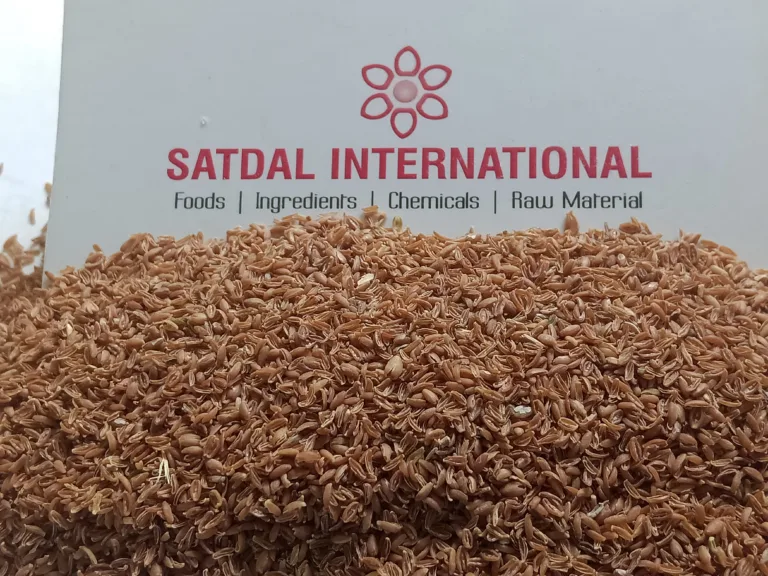
What Are Psyllium Seeds?
Psyllium seeds are the small, oval, dried seeds of the Plantago ovata plant — the same plant that produces psyllium husk, but at an earlier stage in processing. Each seed has two parts: an outer seed coat (the husk, rich in soluble fiber/mucilage) and an inner seed body (the endosperm and embryo, which contains oil and protein). When buyers purchase “psyllium seeds,” they are buying the whole, unhusked seed — before it has been mechanically separated into husk and residual seed.
This matters commercially: a husk buyer wants the fiber coat already removed and graded. A seed buyer wants the intact seed, because they intend to husk it, press it for oil, feed it whole to livestock, or plant it.
Botanical Profile of Psyllium Seeds (Plantago ovata)
| Detail | Information |
|---|---|
| Botanical Name | Plantago ovata Forssk. |
| Family | Plantaginaceae |
| Also Referenced As | Plantago psyllium, Plantago ispaghula |
| Common Trade Names | Isabgol Seed, Ispaghula Seed, Flea Seed |
| Plant Type | Annual herb with a low-growing rosette habit |
| Cultivated Regions (India) | Gujarat (Banaskantha, Mehsana), Rajasthan, and Madhya Pradesh |
| Harvest Season | February–March (Rabi crop) |
| Seed Appearance | Small, boat-shaped seeds (2–3 mm), pinkish-grey to light brown in colour |
Plantago ovata is the primary commercial species for both seed and husk trade; Plantago psyllium is a related species sometimes referenced interchangeably in older trade literature but is botanically distinct and less commonly cultivated for export.
Difference Between Psyllium Seeds and Psyllium Husk
This is the single most important distinction for buyers, and the reason this page and our Husk page target different customers:
| Factor | Psyllium Seeds | Psyllium Husk |
|---|---|---|
| What It Is | Whole, unhusked psyllium seeds. | The outer seed coat (husk) separated mechanically from the seed. |
| Fiber Content | Lower dietary fiber per gram because the husk remains attached to the seed body. | Approximately 75–80% dietary fiber, making it a highly concentrated natural fiber source. |
| Typical Buyers | Food processors, oil extractors, animal feed manufacturers, and seed companies. | Food manufacturers, pharmaceutical companies, nutraceutical brands, and dietary supplement producers. |
| Primary Applications | Further processing, oil extraction, seed planting, and whole-seed animal feed. | Ready-to-use dietary fiber ingredient for food, pharmaceutical, and health products. |
| Oil & Protein Content | Contains natural oil and protein within the seed kernel. | Very low oil and protein content because the husk consists almost entirely of fiber. |
| Price Range | Generally more economical than processed psyllium husk. | Usually higher priced, depending on purity, grade, and fiber quality. |
In short: husk is what you get after processing the seed. Seeds are what you buy if you intend to do that processing — or something else entirely — yourself.
Manufacturing Process
- Procurement — Seeds sourced directly from registered farmers and Gujarat market yards during the February–March harvest window
- Cleaning — Mechanical de-stoning, de-dusting, and removal of foreign organic matter
- Grading — Sieving to remove undersized, broken, or discolored seed
- Moisture stabilization — Drying to safe storage moisture (≤12%) to prevent mold and preserve viability
- Quality testing — Batch testing for purity, foreign matter, and moisture
- Packing — Filled and sealed under controlled humidity conditions
Note: this is not the husking process. If you need husk separated from seed, that’s a separate mechanical operation described on our Psyllium Husk page — we can also supply that finished product directly if you’d rather not process seed in-house.
Industrial Applications
- Husk extraction — Mills and processors buy raw seed to mechanically separate husk from seed body themselves, often to control their own purity grading
- Oil pressing — The seed body contains oil rich in linoleic acid, extracted for cosmetic and nutraceutical applications
- Whole-seed feed inclusion — Used directly in compound feed without further processing
- Seed multiplication — Agricultural buyers purchase seed stock for cultivation in new growing regions
Food Industry Uses
Whole psyllium seed has limited direct food use compared to husk (its fiber is not yet isolated), but it appears in:
- Traditional and regional food preparations where whole seed swelling (rather than isolated fiber) is the desired effect
- Ingredient blends where processors husk the seed in-house as part of a proprietary formulation process
- Seed-based mucilage extraction for small-batch or artisanal food production
For standard food manufacturing (bakery, beverages, fiber fortification), most buyers purchase psyllium husk or husk powder directly rather than raw seed, since husking removes the low-fiber seed body that food formulations don’t need.
Pharmaceutical Uses
Some pharmaceutical and Ayurvedic manufacturers purchase whole seed specifically because their formulation calls for the intact seed rather than isolated husk — traditional Ayurvedic preparations, for example, sometimes specify whole Isabgol seed rather than processed husk. Buyers formulating a standard fiber supplement or laxative product should confirm with their formulation team whether whole seed or graded husk is specified, as the two are not interchangeable in a finished-dose product.
Nutraceutical Uses
The seed body’s oil fraction — containing linoleic acid, an essential fatty acid — is of interest to nutraceutical companies developing seed-oil-based products distinct from fiber-based psyllium supplements. This is a smaller, more specialized buyer segment than the fiber supplement market, and typically involves seed oil extractors rather than fiber formulators.
Animal Feed Applications
Whole psyllium seed is used in compound animal feed formulations, primarily for:
- Digestive health support in cattle and livestock feed
- Poultry feed inclusion in some regional formulations
- Situations where feed manufacturers want the intact seed’s combined fiber-and-nutrient profile rather than isolated husk fiber
Feed manufacturers should specify required particle size and foreign-matter tolerance at time of order, since feed-grade specifications differ from food or pharma-grade requirements.
Quality Specifications
| Parameter | Specification |
|---|---|
| Botanical Source | Plantago ovata |
| Color | Light Brown to Moderate Brown |
| Odor | Faint, Characteristic |
| Taste | Bland, Mucilaginous |
| Moisture (Loss on Drying) | Maximum 12.0% |
| Total Ash | Maximum 4.0% |
| Acid Insoluble Ash | Maximum 1.0% |
| Foreign Organic Matter | Maximum 0.5% |
| Particle Size | Not more than 5.0% retained on U.S.S. 35 mesh |
| Testing Standard | Testing is conducted as per the buyer's requirements or by a NABL-approved laboratory, as mutually agreed at the time of order. |
Physical Characteristics
- Shape: Small, oval to boat-shaped
- Size: Approximately 2–3mm in length
- Surface: Smooth, slightly glossy seed coat
- Color range: Pinkish-grey to light brown, natural variation expected within a batch
- Bulk density: Free-flowing when properly dried and cleaned
Packaging Options
We supply Psyllium Seeds in export-grade packaging suitable for international shipments. Custom packing options are available to meet buyer requirements, private labeling, and country-specific import regulations.
| Pack Size | Typical Use Case |
|---|---|
| 200 g / 500 g | Product samples, laboratory evaluation, and small retail testing. |
| 15 kg / 20 kg | Small-batch manufacturing, pilot production, and trial orders. |
| 50 kg | Standard export packaging for bulk international shipments. |
| Custom Packaging | Available upon request for OEM, private label, and bulk buyers. |
Container Loading Capacity
| Container Type | Approximate Loading Capacity |
|---|---|
| 20 ft Container | Approximately 12 Metric Tons (MT) |
| 40 ft Container | Approximately 17–18 Metric Tons (MT) |
Shelf Life & Storage
Shelf Life: Up to 24 months (2 years) from the date of packing when stored under recommended conditions.
- Store in a cool, dry, and well-ventilated place.
- Protect from direct sunlight and moisture.
- Keep the packaging tightly sealed after opening.
- Follow recommended storage practices to maintain product quality during transportation and warehousing.
Export Markets
Satdal International exports psyllium seeds to buyers across the USA, Canada, UK, Europe, Middle East, Japan, South Korea, Taiwan, Australia, New Zealand, Africa, Latin America, Thailand, Turkey, and other Asian markets — the same established export network we use for our full agri-commodity portfolio.
Why Source Psyllium Seeds from India
India — and Gujarat specifically — grows the majority of the world’s Plantago ovata crop, giving Indian suppliers direct access to fresh-harvest seed with shorter supply chains than markets that rely on imported or aged seed stock. Gujarat’s Unjha market yard infrastructure, built up over decades around the psyllium trade, means seed cleaning, grading, and export logistics are mature and well-established rather than improvised for a niche export.
Why Choose Satdal International
Satdal International sources and exports raw psyllium seed directly from Gujarat’s growing regions, alongside our full psyllium husk and husk powder product line — meaning we can supply whichever form of the product (seed or processed husk) matches your actual manufacturing process. We provide batch-level documentation, sample approval before bulk shipment, and direct support through export logistics.
Frequently Asked Questions
What is the difference between psyllium seeds and psyllium husk?
Who typically buys raw psyllium seed instead of husk?
Can Satdal International supply both raw seed and processed husk?
Is psyllium seed the same as Isabgol seed?
What's the difference between Plantago ovata and Plantago psyllium?
Do animal feed manufacturers use whole seed or husk?
What foreign matter tolerance applies to export-grade psyllium seed?
Can psyllium seed be used for cultivation/replanting?
Conclusion
Raw psyllium seed and processed psyllium husk serve different buyers with different needs — and treating them as the same product leads to sourcing the wrong material for your process. If your operation husks, presses, feeds, or plants the whole seed, this page is your starting point. If you need a finished, purity-graded fiber ingredient ready to formulate, our Psyllium Husk page is the right resource. Satdal International supplies both, directly from Gujarat, India.