
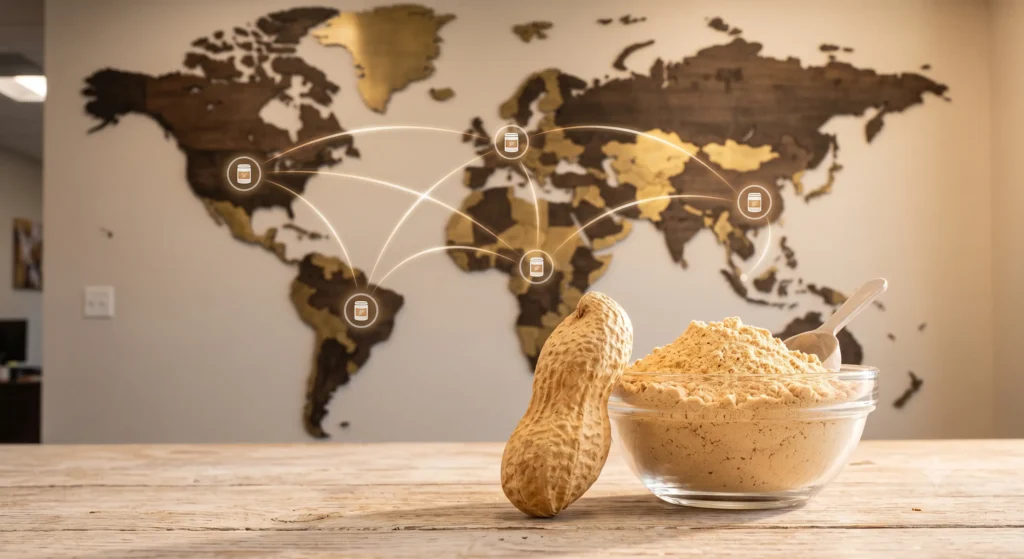
Peanut butter powder has moved from a niche fitness-aisle product to a mainstream functional ingredient sourced by food manufacturers, sports nutrition brands, and bakery producers worldwide. For importers, distributors, and investors evaluating this category, understanding market size, growth trajectory, and trade flow is now a prerequisite for sourcing and portfolio decisions.
Peanut Butter Powder Market Size in 2025-26
Quick answer: The global peanut butter powder market is valued at roughly USD 245.8 million in 2025 and is projected to reach USD 410.5 million by 2032, growing at a CAGR of 7.6%.
This growth rate outpaces the broader peanut butter category, which itself is expanding at a CAGR of roughly 6.5–7% and is forecast to cross USD 10 billion globally by 2030 (source: Mordor Intelligence, Global Peanut Butter Market Report). Powder formats are growing faster because they solve two problems regular peanut butter cannot: a 90% reduction in fat for calorie-conscious formulation, and a shelf-stable, easy-to-blend format that integrates directly into protein powders, bakery mixes, sauces, and beverages without the handling issues of an oil-based paste.
Peanut butter powder market size and CAGR figures above sourced from Persistence Market Research, Peanut Butter Powder Market Size & Growth Analysis (2025–2032).
North America currently holds the largest share of the peanut butter powder market — approximately 44% — driven by established sports nutrition brands and clean-label retail demand. Asia Pacific is the fastest-growing region, fueled by rising fitness culture, Western dietary adoption, and expanding e-commerce penetration across India, China, Japan, and Southeast Asia.
Peanut Butter Powder Market Size in 2025-26
Quick answer: Growth is driven by rising demand for high-protein, low-fat, plant-based ingredients, functional food innovation, and expanding retail and industrial distribution.
Four forces are shaping demand through 2026 and beyond:
- Protein-forward formulation — Peanut butter powder delivers up to 50g of protein per 100g, making it a preferred input for protein bars, RTD shakes, and meal-replacement products.
- Clean-label and low-fat positioning — Brands are reformulating around powders to cut fat and calories without losing peanut flavor, a trend accelerating in North America and Europe.
- Organic and specialty segments — Organic peanut butter powder is the fastest-growing sub-segment, expanding at roughly 9.4% CAGR as buyers prioritize chemical-free, traceable sourcing.
- Industrial and food-service adoption — Bakery, confectionery, ice cream, and infant nutrition manufacturers are increasingly specifying powder over paste for easier metering and longer shelf stability.
Which Countries Produce and Export the Most Peanut Butter Powder?
Quick answer: The United States, China, and India lead global peanut and peanut-derivative production, while China, the Netherlands, and the United States dominate value-based peanut butter exports.
Production capacity for peanut-based ingredients tracks closely with raw groundnut output. The United States, China, and India are consistently the world’s three largest groundnut producers, giving each a structural advantage in downstream processing — including peanut butter powder manufacturing.
On the finished-product trade side, the picture shifts slightly. In value terms, China, the Netherlands, and the United States together account for over half of global peanut butter exports, reflecting both domestic processing scale and re-export/logistics hub activity out of European ports. India, Poland, Germany, Argentina, Mexico, and Canada form the next tier of exporting origins — and notably, India has recorded the fastest export value growth rate among major exporting countries in recent years, a signal of accelerating downstream processing investment rather than raw commodity trade alone.
Major Importing Markets for Peanut Butter Powder
Quick answer: The largest import demand comes from the United States, France, Germany, Japan, and Canada, with strong secondary demand from the Netherlands and UAE.
Import demand concentrates in three zones:
- North America — the largest single consumption base, driven by sports nutrition, retail private label, and food manufacturing.
- Europe — Germany, France, the Netherlands, and Poland import heavily both for domestic consumption and re-distribution across the EU.
- Asia Pacific and Middle East — Japan, South Korea, and UAE are emerging import corridors as Western dietary patterns and protein-fortified food trends spread regionally.
India's Position in the Global Peanut Butter Powder Trade
Quick answer: India is a fast-growing peanut butter powder exporter, leveraging Gujarat's groundnut supply base and competitive FOB pricing to serve global B2B buyers.
India’s advantage is structural: Gujarat alone accounts for a substantial share of national groundnut cultivation, placing processors close to raw material without the inland freight burden that affects competing origins. Combined with FSSAI- and export-certified manufacturing capacity and proximity to Mundra and Kandla ports, Indian exporters can offer bulk peanut butter powder at FOB pricing that is typically more competitive than US, Argentine, or Chinese origins — while meeting FDA, EU, and Halal/Kosher compliance requirements that regulated importers demand.
For distributors and brand managers evaluating supplier diversification away from concentrated North American and European origins, India represents one of the more scalable emerging sourcing bases in this category, particularly for defatted, high-protein grades used in sports nutrition and bakery applications.
Trade Outlook
What This Means for Buyers and Investors
The peanut butter powder category is growing faster than the broader peanut butter market, with structural tailwinds in protein nutrition, clean-label reformulation, and industrial food applications. For importers and brand managers, this points toward tightening supply competition among established origins over the next few years — making early supplier relationships with certified, scalable exporters a meaningful advantage, particularly from emerging origins like India where capacity is expanding alongside export sophistication.
Conclusion
The global peanut butter powder market is on a clear growth path — expanding from roughly USD 245.8 million in 2025 toward USD 410.5 million by 2032 at a 7.6% CAGR, outpacing the broader peanut butter category. Production remains concentrated among the US, China, and India, while export value is led by China, the Netherlands, and the US, with India posting the fastest growth among major exporters. For importers, distributors, and investors, the strategic takeaway is straightforward: this is a category where sourcing diversification and early supplier partnerships — particularly with certified, cost-competitive origins like India — will matter more each year as demand accelerates.
Sources & References:
- Persistence Market Research — Peanut Butter Powder Market Size & Growth Analysis, 2032 (market size, CAGR, regional share, organic segment growth)
- Mordor Intelligence — Global Peanut Butter Market Report (broader peanut butter category size and CAGR)
- WorldsTopExports.com — Top Peanuts Exports & Imports by Country Plus Average Prices, 2025 (top peanut/groundnut exporting countries by value)
- Tridge — Peanut Butter Market Overview, 2026 (HS 200811 export/import country data, leading import markets)
- IndexBox — World Peanut Butter and Prepared or Preserved Groundnuts Market Analysis (export value share by country, India’s export growth rate)
- Satdal International internal sourcing and logistics data (India export infrastructure, port proximity, FOB positioning)
Note: figures cited for “peanut butter powder” specifically (market size, CAGR) are drawn from powder-category-specific market research. Figures on production and export/import countries are drawn from broader peanut and peanut butter trade data, since country-level trade statistics are not separately tracked for the powder sub-category by customs authorities (HS codes group powder under general peanut/groundnut preparation codes). This distinction is noted for buyer and analyst transparency.