India has become one of the most reliable origins for defatted peanut butter powder exports, thanks to its raw groundnut supply chains in Gujarat, competitive processing costs, and growing base of FSSAI- and export-certified manufacturers. For importers, distributors, food manufacturers, and HORECA buyers, the challenge isn’t finding a peanut butter powder supplier from India — it’s finding the right one, with the right specs, certifications, and logistics fit.
This guide walks B2B buyers through the sourcing process end to end: specifications to request, supplier vetting, MOQs, pricing structures, certifications, and shipping logistics.
Why Buyers Are Sourcing Peanut Butter Powder From India
Quick answer: India offers low-cost groundnut supply, FSSAI/export-grade processing, and competitive FOB pricing for bulk peanut butter powder buyers.
Gujarat alone accounts for a large share of India’s groundnut cultivation, giving processors based here direct access to raw material without high inland freight. This proximity, combined with established factory infrastructure, allows Indian exporters to offer bulk peanut butter powder at FOB prices that are typically more competitive than US or South American origins — without compromising on protein content or shelf stability when sourced from a reliable manufacturer.
What Specifications Should Importers Request?
Quick answer: Request fat percentage, protein content, particle size, moisture level, and shelf-life data before placing a sample order.
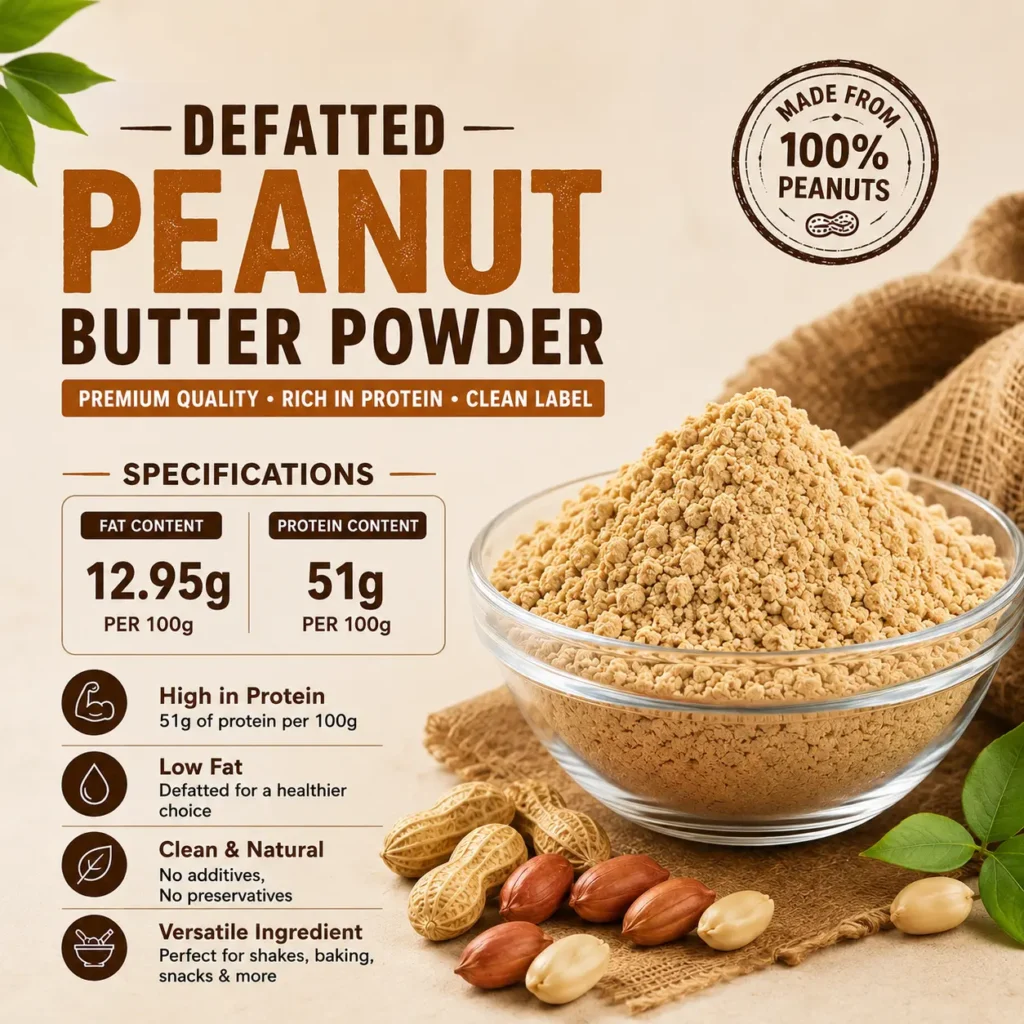
Not all powdered peanut butter is processed the same way, and spec sheets and nutrition vary significantly between suppliers. A serious defatted peanut butter powder manufacturer should be able to provide:
- Fat content — typically ranges from 12% (low-fat) to 16% (standard defatted)
- Protein content — usually 50–54% depending on defatting level
- Particle size / mesh — affects solubility in beverages, baked goods, and protein blends
- Moisture content — critical for shelf stability during ocean freight
- Microbial test reports — especially for buyers supplying bakery, dairy, or RTE (ready-to-eat) segments
- Allergen and aflatoxin testing certificates — non-negotiable for EU and US-bound shipments
Buyers serving HORECA chains or supplement brands should request batch-specific Certificates of Analysis (CoA), not just a generic spec sheet, since formulation needs (smoothies, protein bars, sauces, bakery mixes) differ by fat and particle size.
Certifications That Signal a Trustworthy Exporter
Quick answer: Look for FSSAI, ISO 22000, HACCP, and export-specific certificates like APEDA registration before finalizing a supplier.
For international buyers, certification is the fastest way to filter serious exporters from unverified traders. At minimum, a peanut butter powder exporter should hold:
- FSSAI license (mandatory for any India-based food manufacturer)
- ISO 22000 / FSSC 22000 for food safety management
- HACCP certification for hazard control in processing
- APEDA registration, since groundnut products fall under India’s agricultural export promotion framework
- Kosher / Halal certification, where relevant to the buyer’s end market
- Non-GMO or organic certification, increasingly requested by EU and North American supplement brands
Buyers should ask for certificate copies directly rather than relying on website claims, and cross-check certificate numbers where the issuing body offers public verification.
MOQ, Pricing, and Packaging Options for Importers
Quick answer: MOQs for export orders typically start at 1000 kg to 5000 kg, with pricing quoted FOB per kg based on fat content and packaging.
Pricing for bulk peanut butter powder is driven primarily by fat percentage (lower fat = higher processing cost), packaging format, and order volume. Most Indian exporters structure offers as:
- Sample orders: 500 gm, often couriered for buyer lab testing
- Trial commercial orders: 500 kg– 1000 kg
- Standard export MOQ: 1000 –5000 kg, scalable to full container loads (FCL)
Packaging is typically offered in 25 kg multi-layer kraft/poly bags for industrial buyers, with 1 kg or 5 kg retail-ready pouches available for private label and HORECA repacking. Buyers placing recurring orders should also ask about long-term contract pricing, since locking in a 6–12 month rate protects margins against raw groundnut price fluctuations.
Shipping, Documentation, and Import Logistics
Quick answer: Standard export documentation includes a commercial invoice, packing list, certificate of origin, phytosanitary certificate, and CoA.
Most B2B peanut butter powder sourcing from India moves via sea freight from Mundra or Nhava Sheva ports, with typical transit times of 18–35 days depending on destination. Importers should confirm the exporter handles:
- Commercial invoice and packing list
- Certificate of Origin (and Form A/EUR1 where preferential tariffs apply)
- Phytosanitary certificate (mandatory for groundnut-derived products)
- Fumigation certificate for wooden pallets
- Insurance documentation if quoting CIF
Buyers new to importing from India should also clarify Incoterms upfront — FOB, CIF, and CFR carry different cost and risk allocations, and confusion here is one of the most common causes of shipment delays.
How to Vet a Peanut Butter Powder Supplier Before Ordering
Quick answer: Request samples, verify certifications independently, check export history, and start with a trial order before scaling volume.
A practical due-diligence checklist for first-time buyers:
- Request a paid sample with full CoA, not a free promotional sample alone
- Verify FSSAI and APEDA registration numbers independently
- Ask for export references or past shipment records (Bill of Lading copies, redacted if needed)
- Confirm production capacity matches your projected order volume
- Clarify lead times for both sample and bulk orders in writing
- Start with a trial commercial order before committing to long-term contracts
Suppliers who hesitate on any of these steps — particularly independent certificate verification — warrant additional scrutiny.
Conclusion
Sourcing peanut butter powder from India comes down to three things: verified specifications, real certifications, and a supplier who can scale with your order volume without quality drift between batches. For importers, distributors, and food manufacturers building long-term supply relationships, the upfront diligence on certifications and trial orders pays off in fewer quality disputes and more predictable landed costs down the line.
Satdal International supplies defatted peanut butter powder to global importers, food manufacturers, and HORECA buyers from its Gujarat-based facility, with full CoA documentation and export support from sample to full container load. Request a quote or sample to start the vetting process.
FAQ SECTION
How do I import peanut butter powder from India?
What is the minimum order quantity (MOQ) for peanut butter powder from Indian exporters?
Is peanut butter powder from India FSSAI and export certified?
What is the price of peanut butter powder per kg for bulk import?
What documents are required to import peanut butter powder from India?
Can I get private label peanut butter powder manufactured in India?
How long does shipping take from India to international ports?
What fat content should I choose for food manufacturing applications?
More Blog...
Peanut Butter Powder for Sports Nutrition: Why Fitness Brands Are Switching to Powder