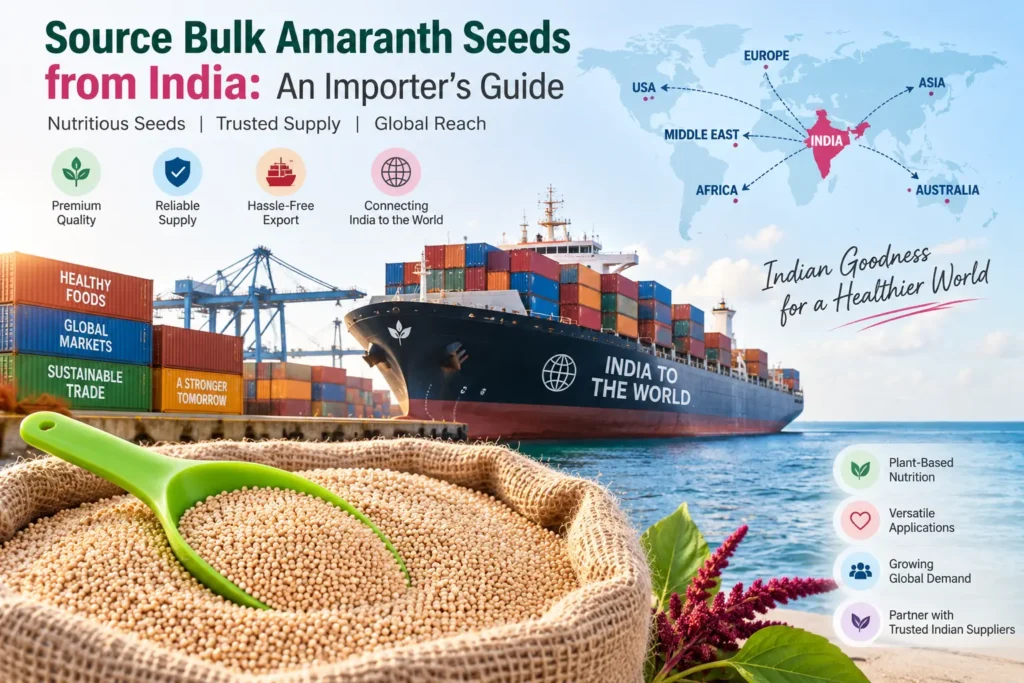
How to Source Bulk Amaranth Seeds from India: An Importer's Guide
Buying amaranth in bulk looks simple until the first container is on the water. A supplier’s sheet says 99% purity, a lab report shows a residue your destination doesn’t tolerate, and the shipping terms leave a gap nobody priced in.
This guide walks through how experienced importers source amaranth seeds from India: what to specify, what to verify, which documents to expect, and how to send an RFQ that produces comparable quotes.
It covers commercial buying of food-grade whole amaranth seeds. For amaranth nutrition and health background or sourcing amaranth flour, see those guides.
Quick answer: how to source bulk amaranth seeds from India
- Define the product: food-grade whole seed, colour/type, end use, destination market.
- Write a specification with test methods and tolerances, not just “99% purity.”
- Shortlist suppliers and check legal identity, facility, traceability and testing.
- Send a structured RFQ (volume, packaging, Incoterm, named port, documents).
- Evaluate a sample and a lot COA
- Confirm destination compliance: phytosanitary certificate, origin, organic documents, US or EU import requirements.
- Agree terms and inspection before the first order.
Requirements vary by destination country. Use this as a framework and confirm specifics with your customs broker or the destination authority.
What you are buying: amaranth, Rajgira and Ramdana
Amaranth grain is the seed of Amaranthus plants. Two species, A. cruentus and A. hypochondriacus, are the ones commonly called amaranth grain, and spec sheets from Indian exporters also list A. caudatus. In India the seed is sold as Rajgira and Ramdana; some suppliers also use Seel or Kiwicha. Ask for the botanical name and colour on the spec, since suppliers list both white and brown types.
Food-grade vs sowing seed. Search results for “amaranth seeds” are full of garden retailers. In a commercial RFQ, state “food-grade, for human consumption, not for sowing.” India’s plant-quarantine authority treats the two differently: export inspection of propagation seed involves sampling and laboratory tests, while consumption commodities get visual examination and similar checks.
Rajgira flour is a different product (rajgira atta), so don’t mix it into a whole-seed RFQ.
Customs classification. Amaranth is generally classified under HS heading 1008 (“other cereals”); the EU tariff code 1008 90 00 lists amaranth. Confirm the 8–10 digit code with your broker.
Why buyers evaluate India as an origin
India is one origin among several. Buyers look at it for the number of experienced exporters, both conventional and organic lots, and an online export-certification system. Phytosanitary certificates are applied for through the government’s PQIS portal.
The trade-off is inconsistent claims. Published figures on Indian supplier pages vary widely: moisture “max 10%” on one page, “≤14%” on another, and foreign matter from ≤0.01% to under 1%. A number on a website is a starting point, not a specification.
Amaranth seed quality specifications to request
Buyers generally work from a spec agreed in the contract rather than one global grade standard. Pair every figure with a test method and sampling plan. Compare Satdal’s current amaranth seed specification against your own requirements.
| Parameter | Ask for | Why It Matters |
|---|---|---|
| Identity and Colour | Botanical name, colour and size uniformity | Helps ensure lot-to-lot consistency in your process. |
| Purity / Admixture | Purity percentage and cleaning method | Helps assess downstream cleaning requirements and associated costs. |
| Foreign Matter, Stones and Other Seeds | Maximum permitted percentage and testing method | Important for product quality, processing efficiency and contamination control. |
| Gravity Separation | Ask whether gravity tables are used during cleaning | Gravity tables can separate same-size seeds with different weights, such as dark pigweed seeds. Ask whether this cleaning method is used. |
| Moisture | Maximum percentage at loading and testing method | One university reference places safe grain storage moisture at around 11%. Ask how the supplier's moisture limit is maintained during transit. |
| Damaged / Broken / Discoloured Seeds | Maximum permitted percentage | Affects processing yield, product appearance and overall quality. |
| Infestation | Live-insect status and fumigation history | Helps reduce the risk of shipment delays, rejection or border issues. |
| Microbiology | Testing panel matched to your intended end use | Popped or ready-to-eat applications may require tighter microbiological controls than products intended for cooking. |
| Pesticide Residues | Multi-residue panel, LOQ and laboratory details | EU rules apply a default limit of 0.01 mg/kg where no specific maximum residue limit is established. |
| Heavy Metals and Mycotoxins | Test results against applicable destination-market limits | Requirements and limits can vary by destination market. |
| GMO, Irradiation and Allergens | Written statements or declarations | Supports labelling, customer specifications and regulatory requirements. |
| Organic Status | Valid organic certificate, scope and certifier | Allows buyers to verify whether the organic claim and certification are applicable. |
| Shelf Life and Lot Coding | Date format, lot number and traceability information | Supports traceability, recalls and management of customer claims. |
How amaranth seeds are processed for export
Processing described by Indian suppliers typically includes gravity separation and optical Sortex sorting before packing. Ask which steps occur in the supplier’s own facility and which are subcontracted, and whether each lot is sampled and coded before loading.
Bulk packaging options
| Amaranth Seed Packaging Format | Typical Use | Buyer Checks |
|---|---|---|
| 25 kg / 50 kg PP Bags | Commonly quoted for export shipments | Food-grade material, inner liner, stitching, labelling and palletisation requirements. |
| 1 MT Bulk Bags | Typically offered for high-volume orders | Confirm handling equipment at your facility, liner requirements and moisture protection. |
| Retail / Private-Label Packs | Some exporters offer 500 g–5 kg consumer packs | Confirm print approvals, destination-market labelling requirements and artwork compliance. |
Packaging changes container payload, so ask for a loading plan. See Satdal’s packaging and enquiry details.
MOQ and commercial considerations
MOQ varies with packaging, conventional vs organic, and shipment mode. Published figures range from around one metric ton, with smaller trial orders possible, up to container loads for export consignments.
Price differences usually trace to purity grade, organic status, packaging, certification, crop year, Incoterm and payment terms. Compare quotes only on the same specification, packing, Incoterm and named port. Ask which crop year the lot is from.
Export documentation checklist
| Export Document | Purpose | Buyer Notes |
|---|---|---|
| Commercial Invoice, Packing List and Bill of Lading | Customs clearance and proof of title | Ensure the names and key shipment details match across all documents. |
| Certificate of Origin | Proof of origin and potential duty treatment | Confirm the required certificate format and requirements for the destination country. |
| Phytosanitary Certificate | Plant-health clearance | Issued by India's plant-protection authority. For non-perishable products, validity before export may be limited to 30 days, so shipment timing should be coordinated carefully. |
| Fumigation Certificate | Evidence of required treatment | Required only when treatment is applicable or specifically requested. It confirms the treatment performed; relevant details may also appear on the phytosanitary certificate. |
| Certificate of Analysis (COA) / Laboratory Reports | Quality, safety and residue evidence | Request the COA and relevant laboratory reports according to the product specification and destination-market requirements. |
| Organic Certificates | Verification of organic claims | For organic imports into the EU, verify the applicable electronic Certificate of Inspection requirements through TRACES. |
| Insurance Certificate | Marine cargo insurance for applicable shipments | Particularly relevant for CIF shipments. Confirm the required level of insurance cover before shipment. |
| Pre-Shipment Inspection Report | Independent verification of shipment or product | If required, agree on the inspection scope, inspection agency and applicable requirements in the sales contract. |
Destination-market compliance: what varies
| Market / Requirement | What International Buyers Should Confirm |
|---|---|
| United States | Prior Notice to the U.S. FDA is generally required before food shipments arrive in the United States. Compliance with the Foreign Supplier Verification Program (FSVP) does not exempt a shipment from Prior Notice requirements. The U.S. importer is responsible for maintaining an FSVP for each covered food and foreign supplier. FDA may also verify applicable food-facility registration requirements during import. |
| European Union | Confirm the applicable maximum residue limits (MRLs) for the destination market, as imported food is subject to the relevant EU requirements. For certified organic products, verify the applicable electronic Certificate of Inspection (e-COI) requirements. |
| Other International Markets | Check the requirements of the destination country's food-safety, customs, plant-health and import authorities before finalising the product specification and shipment documentation. |
| Gluten-Free Claims | The Codex reference threshold for a gluten-free claim is below 20 mg gluten/kg. Buyers should confirm supplier segregation, cross-contact prevention and appropriate testing controls when gluten-free claims are required. |
Certifications buyers may request
| Certificate / Registration | What It Signals | What Buyers Should Verify |
|---|---|---|
| FSSAI Licence | Indian food-business licensing | Verify the facility/site details and licence validity. |
| HACCP / ISO 22000 / GFSI-Benchmarked Scheme | Food-safety management | Confirm that the certification scope covers the exact manufacturing site and the relevant product. |
| Organic (NPOP, USDA NOP, EU) | Organic status | Verify the certifier, certification scope and applicable transaction certificate for each shipment. |
| Exporter Registrations (IEC, APEDA Where Applicable) | Export standing | Verify the registration number and current status. |
| Halal / Kosher / Non-GMO | Customer- or market-driven requirements | Request a copy of the relevant certificate and verify the issuing body. |
How to evaluate an Indian amaranth seed supplier
| Supplier Evaluation Area | What Buyers Should Check |
|---|---|
| Legal Identity | Verify company registration details, Importer Exporter Code (IEC), and relevant export history. |
| Role in the Supply Chain | Confirm whether the supplier is a manufacturer, trader, exporter, or sourcing partner. Ask who actually cleans, processes and packs the amaranth seeds. |
| Traceability | Check the farm or aggregation source, lot coding system and retained-sample procedure. |
| Testing | Ask which laboratory performs testing, whether it has appropriate accreditation, testing frequency and which pesticide-residue panel is covered. |
| Documentation | Request a sample set of previous shipping documents and confirm the expected document turnaround time. |
| Sample Policy | Confirm whether the pre-shipment sample can be linked to the specific production or shipment lot being supplied. |
| Problem Handling | Understand the supplier's complaint, non-conformance and claims handling process before placing an order. |
| Communication | Confirm the named contact person, expected response time and the supplier's process for communicating specification or product changes. |
Questions worth asking any supplier:
- Which lot does this sample represent?
- What is your moisture at loading, and how is it measured?
- Which laboratory issues the residue results, and what is the LOQ?
- What happens if my destination lab disagrees with your COA?
- Can I appoint independent pre-shipment inspection?
- Which crop year is this?
How to prepare an RFQ
| RFQ Field | What to Include |
|---|---|
| Product | Food-grade whole amaranth seeds, including the botanical name and required colour. |
| Specification | Attach the complete product specification, including applicable testing methods. |
| Volume | State the required quantity per shipment and estimated annual volume or forecast. |
| Packaging | Specify bag type, pack size, labelling requirements and palletisation requirements. |
| Delivery | State the required delivery window, preferred Incoterm and named port or delivery location. |
| Destination | Specify the destination country and intended end use of the amaranth seeds. |
| Certifications | Specify whether organic certification or other customer- or market-specific certifications are required. |
| Testing | Specify the required pesticide-residue panel, laboratory requirements and limit of quantification (LOQ). |
| Documents | Provide the complete list of documents required for the shipment and destination market. |
| Commercial Terms | State preferred payment terms, quotation validity period and required crop year. |
| Samples | Specify the required sample quantity and preferred timing for sample submission. |
| Inspection | State whether third-party pre-shipment inspection is required and, where applicable, identify the inspection agency. |
How to evaluate samples and COAs
| Quality Check | What Buyers Should Do |
|---|---|
| Pre-Shipment Sample | Confirm that the sample is drawn from the specific production or shipment lot being offered. |
| Certificate of Analysis (COA) | Match the lot number and test date. Check the testing method, laboratory, measurement units and whether the limit of quantification (LOQ) is sufficiently low for the applicable destination-market maximum residue limits (MRLs). |
| Independent Laboratory Test | Test the amaranth seeds through your own laboratory or an independent third-party laboratory against the agreed product specification. |
| Counter-Sample | Keep a sealed, properly identified retained sample for future reference and potential quality or shipment disputes. |
| Arrival Check | Compare the received shipment against the supplier's COA and agreed specification before releasing the stock for production or sale. |
How to evaluate samples and COAs
- FOB, CFR and CIF apply to sea transport only, and for CFR and CIF, risk passes when the goods are on board at the port of shipment, even though the seller pays freight. ICC Academy
- CIF adds seller-arranged insurance, but the minimum required cover is Institute Cargo Clauses (C). Supply Chain Math
- Containers: ICC guidance recommends FCA, CPT or CIP for containerised cargo because the box is handed over at a terminal. Many suppliers still quote FOB/CFR/CIF for containers, so agree the term and named place explicitly with your forwarder. Mightyshipping
How to evaluate samples and COAs
- Accepting percentages without test methods.
- Comparing quotes with different specs or Incoterms.
- Treating a clean COA as proof of compliance without checking the LOQ.
- Forgetting the phytosanitary certificate’s validity window.
- Not stating “food-grade, not for sowing.”
- Skipping an independent test on the first shipment.
- Assuming one market’s rules apply everywhere.
Why work with an India-based sourcing partner
Sourcing from India involves supplier checks, document sequencing, sampling and shipping coordination across time zones. A local partner can shorten those loops, but the checks in this guide apply whoever you work with.
How Satdal International can help
Satdal International is an India-based sourcing and export marketing company. For amaranth seeds, the team works with importers on specification alignment, documentation planning and shipment coordination. Current specification details and the enquiry route are on the Amaranth Seeds page.
FAQ
Where can I buy amaranth seeds in bulk from India?
How do I choose an amaranth seed supplier in India?
What specifications should I request?
What documents are needed to import amaranth seeds?
What packaging is available?
Can amaranth seeds be supplied as organic?
What should I check in an amaranth COA?
How should I prepare an RFQ?
What is the MOQ for bulk amaranth seeds?
Can amaranth seeds be shipped internationally?
Ready to send your requirement?
Send your specification and destination details, and request amaranth seed specifications or ask the sourcing team to review your RFQ.
Sources referenced (hyperlink where used):
- DPPQS: https://ppqs.gov.in/divisions/plant-quarantine/import-export-procedure
- EUR-Lex MRL summary: https://eur-lex.europa.eu/EN/legal-content/summary/pesticide-residues-in-food-and-animal-feed.html
- European Commission MRL Q&A: https://food.ec.europa.eu/plants/pesticides/maximum-residue-levels/qas-pesticides_en
- EU organic trade: https://agriculture.ec.europa.eu/farming/organic-farming/trade_en
- FDA FSVP: https://www.fda.gov/food/food-safety-modernization-act-fsma/final-rule-foreign-supplier-verification-programs-fsvp-key-requirements
- FDA importing human foods: https://www.fda.gov/industry/importing-fda-regulated-products/importing-human-foods
- ICC Incoterms 2020 (CFR/CIF): https://academy.iccwbo.org/incoterms/article/incoterms-2020-cfr-or-cif/
- Codex gluten-free threshold review: https://pmc.ncbi.nlm.nih.gov/articles/PMC13277960/
- Purdue amaranth reference: https://hort.purdue.edu/newcrop/afcm/amaranth.html
More Blog...
Peanut Butter Powder for Sports Nutrition: Why Fitness Brands Are Switching to Powder