
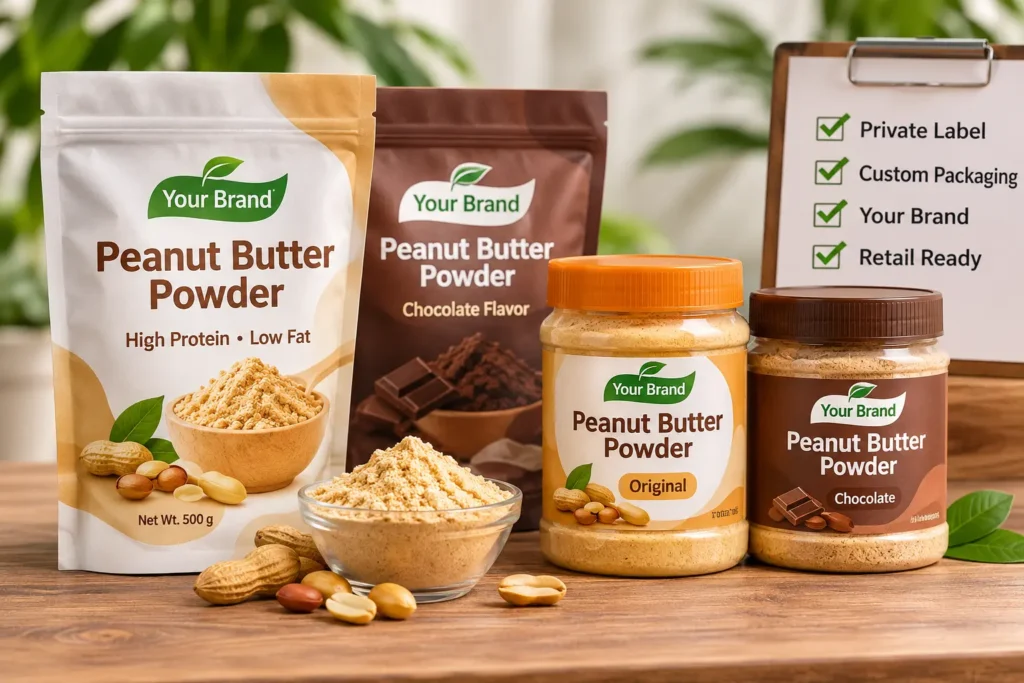
Peanut butter powder is selling under your own name looks like simple: choose a product, add a label, ship it. In practice, a brand owner makes decisions that a bulk ingredient buyer never faces. Which specification do you have? Who fills and prints your packs? Whose name goes on the label? Which rules applicable to complete pack in your market?
This guide covers those decisions for brands, retailers, private-label buyers and entrepreneurs planning a launch with an Indian manufacturer.
Short answer: To launch a private label peanut butter powder brand from India, define your product and pack, find a manufacturer that can produce and pack to your specification, approve samples and artwork, run a pilot batch, then arrange export and import clearance. Quantities, costs and lead times depend on the manufacturer, pack format and destination market, so get them in writing. In many markets, the business whose name is on the pack, or the importer, carries legal responsibility for the label.
What Is Private Label Peanut Butter Powder?
Private label peanut butter powder is a product made by one company and sold under another company’s brand name. Peanut butter powder (also called powdered peanut butter) is made from roasted peanuts pressed to remove most of oil, then ground into powder form. For a short explanation, see how peanut butter powder differs from regular peanut butter.
Private Label vs OEM vs Contract Manufacturing
Suppliers use these terms loosely. Write down what is included in your agreement.
| Term | What It Usually Means | Who Controls the Specification |
|---|---|---|
| Private Label (Sometimes “White Label”) | The manufacturer's existing product, packed under your brand. | Mostly the manufacturer; limited changes may be possible. |
| OEM | The manufacturer produces according to a specification you define. | You, subject to the agreed manufacturing arrangement. |
| Contract Manufacturing | The manufacturer produces according to your formulation or process under a supply agreement. | You, subject to technical feasibility and the agreement. |
| Bulk Ingredient Supply | Powder supplied in bulk for you to repack or use in your own products. | The supplier controls the delivered specification; you control subsequent use and processing. |
- Define the product and channel. Retail consumers, sports nutrition, foodservice or food manufacturers each need different specs and packs. If you will sell to manufacturers, see applications in food manufacturing.
- Write a one-page specification (details below).
- Shortlist manufacturers and compare them on private-label capability, not price alone.
- Approve samples: product first, then packed samples.
- Design packaging and labels, and have them reviewed for your destination market.
- Run a pilot or first production batch and check it against your approved sample.
- Arrange export and import clearance, including who acts as importer.
- Launch, then set a reorder plan with agreed change control.
Which Specifications Should You Lock Before Requesting Quotes?
A vague request such as "high-protein peanut powder" produces quotes you cannot compare. Settle these points first.
| Decision | What to Define | Why It Matters |
|---|---|---|
| Product Type | Unflavoured, flavoured, sweetened or chocolate. | Drives the product name and ingredient list. |
| Fat and Protein | Target ranges and the test method. | Ranges differ between suppliers. See typical nutrient ranges . |
| Particle Size | Mesh or particle range. | Affects mixing, mouthfeel and sediment. |
| Moisture | Maximum level. | Affects shelf stability. |
| Ingredients | Any added sugar, salt, sweetener or flow agent. | Appears on your label. |
| Contaminant Limits | Aflatoxin and microbiological limits for your market. | Limits vary by destination. |
| Pack and Fill Weight | Format, size and tolerance. | Sets cost and shelf presentation. |
| Shelf Life | Claim, storage conditions and validation in your actual pack. | Bulk-bag shelf life does not automatically apply to a retail pouch. |
| Sensory Standard | An approved reference sample. | Gives you a benchmark for every batch. |
Any nutrition or content claim ("high protein," "low fat") must match tested values and your destination market's claim rules.
How Do You Evaluate an Indian Private Label Manufacturer?
For the general verification steps (certificate checks, references, trial orders), use the full supplier checklist. Private label adds these questions:
• Who actually manufactures and packs the product? Ask for the site name and address, and confirm it matches the licence and certificates.
• Can they fill and print your pack format? Ask about MOQ for each packing format.
• How do they handle artwork, including templates, proofs and sign-off?
• How do they control peanut allergen cross-contact, especially if the site handles other allergens?
• Can they trace each batch to raw material and packaging lots?
• Will they keep retained samples from every lot?
• How do they manage changes to ingredients, packaging suppliers or process?
• Will they sign confidentiality terms covering your formula, artwork and customers?
• Does their capacity match your forecast?
Packaging, Branding and Label Requirements
Pack Formats
Retail pouches, jars, sachets for Hotel foodservice, and bulk bags for repacking. Ask about moisture and oxygen barrier, reseal or closure type, fill tolerance, and batch and best-before or expiry date.
Label Content
Requirements vary by market. A typical checklist covers:
- Product name and ingredients
- Allergen declaration for peanuts
- Net quantity
- Nutrition panel in your market’s format
- Batch and best-before date
- Storage and preparation instructions
- Business name and address
- Country of origin
- Required languages
- Barcodes
Check all the instructions yourself before printing them.
Artwork Approval
Ask for the pack template, send artwork in the format the printer needs, and approve a proof. Have your label reviewed for the destination market before sign-off. Changes after printing cost time and money.
Private Label Peanut Butter Powder: Cost Components
Figures change with supplier, pack and season, so this guide gives none. Treat any number you are quoted as valid only if it is in a written quotation.
| Cost Component | What Drives It |
|---|---|
| Powder Price per kg | Grade, fat level, flavour, order size. |
| Packaging Materials | Pack type, print method, barrier. |
| Printing Set-up | Artwork, plates or cylinders, design changes. |
| Filling and Packing | Pack size and line type. |
| Testing and Documents | Batch certificates, third-party tests, inspections. |
| Freight and Insurance | Incoterm, container or consolidated load. |
| Duties, Taxes, Clearance | Destination market. |
| Label Review and Registrations | Destination market. |
| Samples and Courier | Number of rounds. |
MOQ questions: Is the minimum per SKU, per pack format or per order? Do printed-packaging minimums differ from powder minimums? Can volume be split across SKUs?
Lead time stages: specification sign-off, samples, artwork approval, packaging procurement, production slot, quality release, shipping, import clearance. Packaging procurement can set the critical path on a first order. Ask for a written timeline.
Samples, Testing and Quality Assurance
| Stage | Purpose | What to Check |
|---|---|---|
| Specification Sample with Certificate of Analysis | Confirm product matches spec. | Taste, colour, texture, lab values. |
| Packed Sample | Confirm the pack works. | Seal, closure, label legibility, barrier. |
| Pilot or First Batch | Confirm consistency. | Comparison to your approved reference. |
| Pre-shipment Sample and Certificate | Confirm the shipped lot. | Match to approved sample. |
| Retained Samples (Both Sides) | Resolve disputes. | Stored per lot. |
Ask which tests are done in-house and which by an external laboratory. Typical tests include aflatoxin, moisture, microbiology, and protein and fat for your nutrition panel. Market-specific tests may apply.
Food Safety Certificates: What They Prove and How to Verify Them
No single certificate is required everywhere. What you need depends on your destination market, your retail customers and your claims.
- Check the certificate scope, site address, issue and expiry dates, and issuing body. It should cover the site that makes your product.
- FSSAI is India’s food safety regulator. Ask for the licence of the manufacturing site.
- APEDA registration: APEDA’s procedure lists groundnut among products where manufacturer-exporters show FSSAI or Udyam proof for registration. The registration certificate is issued through the DGFT portal and requires an Import Export Code (APEDA). Ask APEDA or your manufacturer whether your product’s tariff code is covered.
- Food safety management certificates (for example ISO 22000, HACCP, BRCGS, FSSC 22000) show a system audited by a certification body. Retailers often name the scheme they require.
- Halal, Kosher, organic and non-GMO matter only if your market or claims need them. Never print a claim you cannot document.
The FDA does not certify, license or approve individual importers, products, labels or shipments. Foreign facilities must be registered (FDA). Registration details are not public, so ask for the number and have your US customs broker or regulatory adviser confirm it (FDA). Avoid “FDA approved” or “FDA certified” wording.
Export Documentation and Shipping for a First Order
The standard document list is covered in the guide to export documents for peanut butter powder. For a private label order, also settle:
- Incoterm, which decides who pays and who carries risk.
- Importer of record in your market.
- Carton and pallet labelling, including shipping marks.
- Compliance review before shipment. Relabelling at destination is slow and costly.
Destination-Market Labelling and Compliance
This is a summary, not legal advice. Confirm each point with a qualified adviser or the local authority.
| Market | Points to Check |
|---|---|
| United States | Peanuts are a major food allergen and must be declared (FDA). Foreign facilities must be registered and prior notice given. Importers have FSVP duties (FDA). "Peanut butter" is a standardised food: ground roasted peanuts with seasonings capped at 10% by weight (21 CFR 164.150). Have the product name reviewed. |
| European Union | The operator whose name is on the food, or the importer if that operator is outside the EU, is responsible for the food information (FSAI). Peanuts are among the 14 allergens in Annex II of Regulation 1169/2011 and are emphasised in the ingredient list (Regulation 1169/2011). Aflatoxin limits are in Regulation (EU) 2023/915 (CBI). Groundnut products from India have been on the increased-checks list for aflatoxin, and frequencies change, so check the current annex of Regulation (EU) 2019/1793. |
| United Kingdom | The UK keeps its own version of these labelling and import rules. Check current Food Standards Agency guidance. |
| Other Markets | GCC states, Canada, Australia, Japan and others have their own language, registration and nutrition-panel rules. Ask a local importer or adviser. |
Common Private Label Sourcing Mistakes
- Comparing price per kg only. Compare landed cost per finished pack.
- Writing a vague specification. Use numeric ranges and named test methods.
- Approving artwork before compliance review. Review first, print second.
- Skipping the packed sample. Pack barrier and shelf life need testing in the real pack.
- Accepting a certificate copy without checking scope and site.
- Assuming the manufacturer’s label template meets your market.
- Launching several flavours at once. Starting with one core product (a practical suggestion, not a rule) keeps first-run risk lower.
- Leaving change control and confidentiality undocumented.
Questions to Ask Before Your First Order
- Which site makes and packs my product, and what is its licence number?
- What is the MOQ per SKU and per pack format?
- What are the printed-packaging minimums?
- What does the quotation include, and what is extra?
- What specification and tolerances will you guarantee in writing?
- How do you control peanut allergen cross-contact?
- Which tests do you run on each lot, and by which laboratory?
- How are batches traced and retained samples kept?
- What is the written timeline from sample approval to shipment?
- What happens if a lot fails my specification?
Pre-Order Readiness Checklist
- ☐ One-page specification agreed and signed
- ☐ Reference sample approved
- ☐ Packed sample approved
- ☐ Artwork reviewed for the destination market, then signed off
- ☐ Certificates checked for scope, site and dates
- ☐ Incoterm and importer of record agreed
- ☐ Written quotation covering MOQ, packaging and lead time
- ☐ Confidentiality and change-control terms agreed
- ☐ Destination import requirements confirmed with your adviser or broker
How Satdal International Can Help
Satdal International is an India-based sourcing, supplier coordination and international trade facilitation company. We work with ingredient buyers from specification discussion through to export coordination. For private label projects, we can help brand owners discuss specifications, request samples, coordinate packaging formats and label artwork, and arrange export documentation and shipments. Final label compliance remains the brand owner’s and importer’s responsibility, so we recommend a destination-market review before printing.
To discuss your project, review the peanut butter powder specifications and bulk supply options or request a quote and sample. Include your target market, pack format, flavour and estimated volume.
Frequently Asked Questions
Private label usually means a manufacturer's existing product packed under your brand. OEM means the manufacturer produces to a specification you define. The terms overlap, so confirm what is included in writing.
In many markets, the business whose name is on the pack, or the importer, carries responsibility.
Peanut Butter is just paste while Peanut butter powder is fine powder. Before printing your packaging, consult a qualified US food-labelling specialist or regulatory adviser.
Yes, you can order full container. However, we also supply LCL shipment.
Use a written supply agreement with confidentiality terms. And check trademark availability in your target market. Consult your lawyer for contract terms.
It depends on samples, artwork approval, packaging procurement, production scheduling and shipping. Ask for a written timeline covering each stage.